Français
  English
 ECONOMY - THAILAND OVERTAKES FRANCE IN THE GLOBAL COMPETITIVENESS RANKINGS
Thailand has climbed five places this year, rising from 30th to 25th in the global competitiveness rankings, overtaking France for the first time, which has slipped to 31st place.
Well, if we wanted to be a bit mean, we could say that overtaking France in terms of competitiveness isn’t exactly a great achievement… Ha, ha, ha… no, that’s not nice, we won’t say that…
Nevertheless, we must acknowledge Thailand’s progress, and when you’ve been visiting regularly for over 20 years, you can immediately see what this beautiful country’s goals are... I remember a trip to Koh Samui in 2005 when I said: “Thailand is moving further and further in a high-end direction and will soon become too expensive for Europeans.”
Since we’ve been developing our presence in Asia (Thailand and Cambodia), we’ve noticed the incredible dynamism of these countries and the speed at which they’re advancing. In fact, the world’s biggest players are all on the ground trying to secure a foothold; the Chinese, in particular, are arriving in force with hundreds of millions of dollars.
In conclusion, well done to Thailand, and let investors be aware that those who hesitate will find there is no room left for them later on...
Alain Farrugia
Thailand has climbed five places this year, rising from 30th to 25th in the International Institute for Management Development (IMD) World Competitiveness Ranking.
At the same time, France has dropped three places, falling from 28th to 31st.
The International Institute for Management Development (IMD), based in Switzerland, assesses the economic performance of 63 economies each year.
Thosaporn Sirisamphand, Secretary-General of the National Economic and Social Development Council (NESDC), said that Thailand had made significant progress across the three criteria of infrastructure, economic performance and government efficiency.
Singapore was ranked first, up from third place last year, taking the United States’ place at the top of the rankings. Hong Kong occupies second place, unchanged from 2018. Switzerland and the United Arab Emirates round off the top five.
In South-East Asia, Singapore is followed by Malaysia (unchanged in 22nd place), Thailand, Malaysia and the Philippines (46th, up from 50th).
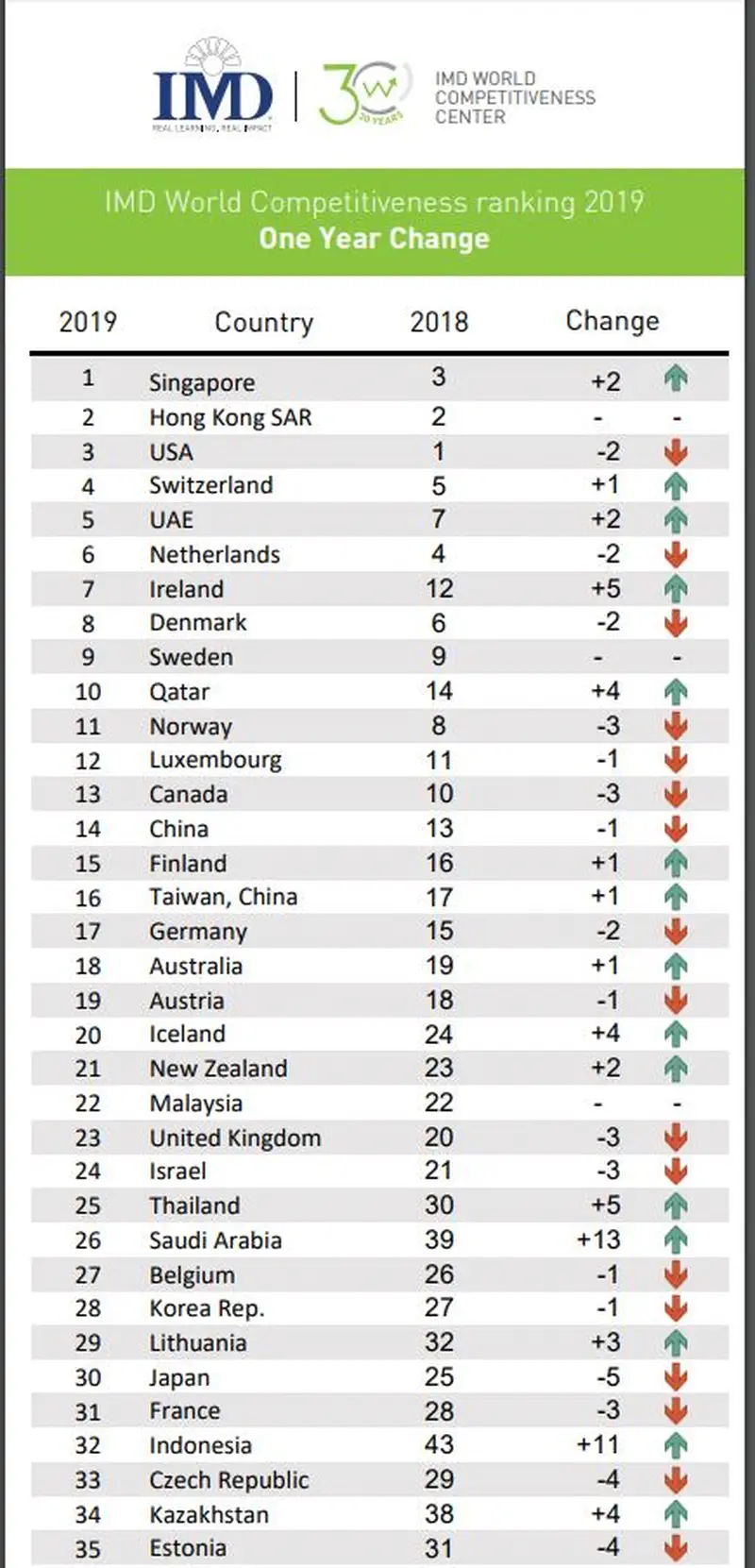
The Asia-Pacific region has emerged as a leader in global competitiveness, with 11 out of 14 economies improving or maintaining their rankings, with Singapore and the Hong Kong SAR leading the global rankings.
Indonesia jumped eleven places to 32nd, benefiting from several improvements, thanks to greater public sector efficiency as well as better infrastructure and economic conditions.
Thailand, driven by an increase in foreign direct investment and productivity, rose five places to 25th position in 2019. Japan fell five places due to rising public debt and a weakening business climate.
Economists consider competitiveness to be vital for the long-term health of a country’s economy, as it enables businesses to achieve sustainable growth, create jobs and, ultimately, improve the well-being of citizens.
The IMD World Competitiveness Rankings, established in 1989, incorporates 235 indicators across each of the 63 economies ranked.
The ranking takes into account a wide range of ‘hard’ statistics such as unemployment, GDP and public spending on health and education, as well as ‘soft’ data from an opinion survey covering topics such as social cohesion, globalisation and corruption.
The data is categorised into four areas – economic performance, infrastructure, government effectiveness and business efficiency – to produce a final score for each country.