Français
  English
 THE GREAT TURNING POINT – WHY THE FUTURE BELONGS TO THOSE WHO CHOOSE THEIR OWN LIVES, THEIR COUNTRY AND THEIR FREEDOM
For decades, the model for success seemed set in stone: living where the work is, accepting geographical constraints, putting up with a sometimes harsh climate, rising living costs, increasing tax burdens and a pace of life dictated by traditional economic hubs. That era is gradually coming to an end.
We realised back in the 1990s that remote working would be the future, and over the last 20 years we have continually refined our international remote working processes with our partners and clients.
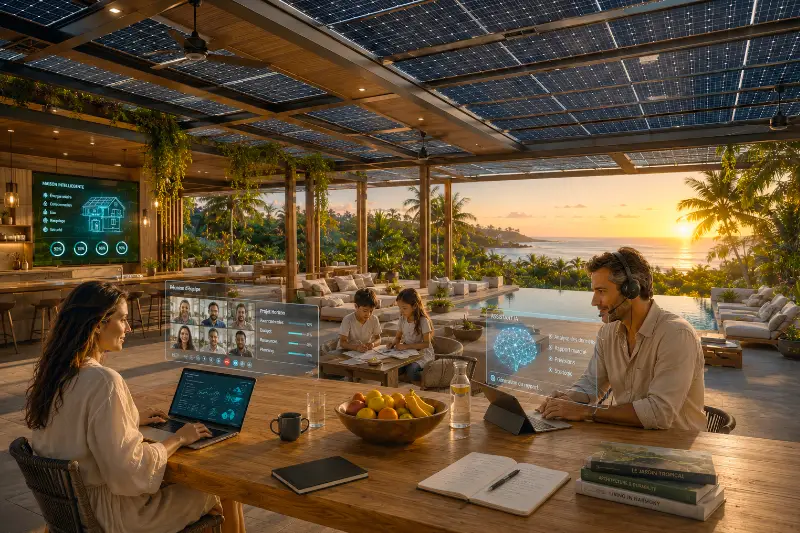
The process works perfectly; productivity is far better and the quality of life is incomparable to ‘face-to-face’ work in offices, which involves commuting, time wasted in traffic jams, and transport and maintenance costs, all for much lower productivity and far poorer quality.
For a family, it is a fantastic opportunity to offer their children a broader cultural experience, the chance to learn several languages, and the most suitable level of education. Not to mention living in the heart of nature, far from pollution, with much better quality food, or the risks associated with crime, which we no longer even think about.
We could also mention the astronomical differences in the cost of living depending on where you live… but there’s no need to spell it out, because when we talk about Switzerland, everything is cheaper elsewhere… Not to mention the far wider and more diverse range of legal tax optimisation opportunities.
Moreover, Marc Benioff, the CEO and founder of the American software giant Salesforce, In May 2020, at the start of the COVID-19 pandemic, stated that the days when thousands of people crammed into skyscrapers were over, adding specifically that an office building housing 25,000 people who commute to work every day was now a thing of the past.
With our new partner ARIEL-IA, their organisation has operated in this way from the outset, 100% remotely across five continents, and their extremely high level of expertise is clear proof that top talent does not need to share a physical office to create products of world-class technical perfection, such as ARIEL-IA/ ARCAN, ARCAN for example, their unbreakable military-grade AES-256-GCM encryption software and all their other cutting-edge technologies.
And if we’re looking for an eco-friendly conclusion, it’s also worth noting that remote working is the least ‘polluting’ of all, with a minimal carbon footprint compared to working in person.
Alain Farrugia
The new remote working revolution is here, thanks to AI
We are currently witnessing a historic transformation comparable to the Industrial Revolution, but of a radically different nature: a revolution in geographical, energy and professional freedom.
Three major forces are currently converging to reshape the way we live:
- dematerialised work made possible by artificial intelligence and digital tools;
- energy independence thanks to renewable technologies;
- international mobility, making it easier to choose a higher quality of life.
Together, these transformations are paving the way for a reality once reserved for a privileged minority: living better, in a place of one’s choosing, whilst maintaining a solid and sustainable economic activity.
Work no longer has a fixed address
For centuries, work dictated where people lived. Factories required physical proximity. Offices concentrated talent in major cities. Employees adapted to the location.
Today, artificial intelligence is reversing this logic.
The rise of intelligent automation, digital assistants, assisted creation, predictive analytics, automated development, advanced communication tools and remote management is profoundly transforming our relationship with work. More and more professions are becoming partially or entirely independent of a physical location.
Consultancy, design, international trade, property, wealth management, training, marketing, media, finance, engineering, creative arts, programming, writing, strategic consulting: value is now created through skill and intelligence, not location.
AI does not merely replace certain jobs; it boosts human productivity to unprecedented levels.
One of the most profound transformations of this new era concerns not just work or energy.
It directly affects the way we inhabit the world.
For the first time in modern history, it is becoming genuinely possible to choose where to live not out of economic or professional necessity, but based on climatic, aesthetic and emotional affinity.
The world is becoming a map of lifestyles.
And each climate zone corresponds to a different human experience:
- Tropical and coastal zones: for those seeking mild warmth, the ocean, lush vegetation, and a fluid, organic pace of life, where the outdoors becomes a permanent extension of the home.
- Southern Europe: for a balance between culture, light, a warm temperate climate, fine dining and proximity to major infrastructure, with a stable and structured quality of life.
- Lush countryside: for those who prioritise space, tranquillity, nature, independence, a slower pace of life and a deep reconnection with the natural world.
- Dynamic urban environments: for connected, creative and entrepreneurial individuals, drawn to economic hubs, a wealth of opportunities, networks and the fast pace of interaction.
- Mountainous areas: for lovers of cool air, majestic landscapes, restorative silence and stable weather, with an almost introspective dimension to daily life.
- Deserts and arid zones: for those seeking dry heat, voluntary isolation, mental clarity and a form of radical minimalism, where space becomes an absolute luxury.
What is changing profoundly is that these choices are no longer exclusive or set in stone.
A single individual may now experience several of these lifestyles over the course of a lifetime, or even alternate between them depending on the seasons, career plans or personal cycles.
We no longer choose just one country.
We choose an evolving geography of life, and the choice of where to live becomes paramount.
The great revaluation of quality of life
Why continue to endure eight months of cold weather, heatwaves, excessive property market pressure, skyrocketing costs, growing insecurity or an anxiety-inducing pace of life when technology makes another model possible?
This question, once marginal, is now central.
Expatriation is no longer just about tax avoidance or an exotic adventure. It is becoming a genuine pursuit of quality of life.
There are many pleasant countries to live in that now offer a particularly attractive combination:
- a manageable cost of living;
- a pleasant climate all year round;
- high levels of everyday safety;
- more affordable housing;
- better quality food;
- modern infrastructure;
- sometimes more favourable tax regime;
- a better work-life balance.
It is no longer simply a matter of ‘moving to the sun’, but of rebuilding a living environment more in line with one’s deepest aspirations: health, peace of mind, free time, closeness to nature, and personal and family balance.
The future will likely belong less to those who own the most than to those who have wisely chosen where to live.
Energy: the invisible backbone of this new freedom
However, this transformation cannot happen without an energy revolution.
The high-quality, resilient and connected lifestyle of tomorrow will require abundant, stable, local and clean energy.
Here too, the world is changing rapidly.
Solar, wind, hybrid systems, energy recovery, smart storage and renewable infrastructure are already transforming regions.
Innovative concepts such as multi-purpose energy infrastructure – notably energy production integrated into existing infrastructure – demonstrate that it is becoming possible to generate energy on a massive scale without further urbanising the land.
The energy of tomorrow will not only be greener.
It will be distributed, smart and resilient.
Producing clean energy locally means:
- reducing structural costs;
- limiting geopolitical dependence;
- improving regional resilience;
- supporting more sustainable housing;
- enabling a more self-sufficient lifestyle.
A home powered by smart renewable systems is no longer an ideological luxury.
It is gradually becoming a rational standard.
The housing of the future will be energy-focused rather than merely architectural.
Housing: towards living spaces designed with people in mind
Housing is also undergoing a profound transformation.
For a long time, property was viewed as a speculative asset.
In the future, it will need to return to being an optimised living space.
New residential models will need to incorporate:
- energy self-sufficiency;
- smart resource recovery;
- greenery;
- natural thermal comfort;
- advanced connectivity;
- integrated remote working;
- flexible mobility;
- digital security.
Housing will no longer be just a roof over your head.
It will become a platform for living.
Residences designed to accommodate remote working, personal balance, well-being, health and harmonious integration into their surroundings will become the norm for mobile and international populations.
Quality of life will become an investment as important as financial returns.
The other silent revolution: digital sovereignty
But this new freedom raises a crucial question:
How can we protect our digital lives in a hyper-connected world?
Working remotely, managing international income, property assets, professional communications and personal data requires radically enhanced cybersecurity.
Artificial intelligence offers extraordinary productivity gains.
It also increases the risks.
Automated cyberattacks, industrial espionage, hacking of sensitive data, information manipulation: the threats are growing exponentially.
Digital sovereignty is therefore becoming a fundamental pillar of the international way of life.
The future will belong to individuals and organisations capable of combining:
mobility + artificial intelligence + absolute data protection.
Without digital security, geographical freedom remains fragile.
Without energy independence, resilience remains limited.
Without quality of life, economic success gradually loses its meaning.
The emergence of a new model of civilisation
What is taking shape is not simply a career change or a trend towards expatriation.
We are witnessing the emergence of a new societal paradigm.
A society where:
- work follows the individual;
- energy respects nature;
- housing genuinely improves life;
- technology protects rather than enslaves;
- geography becomes a choice rather than a constraint.
The future could belong to a new generation of global citizens: mobile, skilled, technologically enhanced, energy-resilient and deeply committed to their quality of life.
Tomorrow’s success may no longer be measured solely by income.
But by the ability to choose freely:
Where to live, how to work, what energy to use, how to protect one’s data, and in what environment to raise one’s family.
Ultimately, the future may be nothing more than a return to a simple idea:
Finally putting technology at the service of people — and not the other way round.