Français
  English
 DEVELOPMENT - SOLAR ENERGY HAS GREAT POTENTIAL IN SWITZERLAND
According to the Swiss Federal Office of Energy, the roofs and facades of houses in Switzerland could generate 67 TWh of solar electricity per year. Up to 40 times more electricity thanks to solar energy: harnessing the power of the sun is one of the simplest ways to help protect the climate.
This article highlights, above all, the need to bring about Switzerland’s energy transition from fossil fuels to 100% renewable energy as quickly as possible. Unfortunately, it is incomplete as it only discusses the roofs and façades of buildings; whilst this is already a good solution, we know that, given all the regulations governing alterations and installations in the building sector, it will take a very, very long time before all the façades and roofs in Switzerland are covered with solar panels…
One thing is also certain: the cost of electricity will continue to rise (see below; Lausanne is already forecasting this increase for 2021), and this rise in electricity prices is likely to be exponential with new technologies such as blockchain, cloud computing, remote working, electric vehicles, and so on…
…So the solution is to rapidly roll out industrial producers of cheap green electricity across Switzerland.
EnergyPier is THE revolutionary solution, with numerous associated positive externalities, the quickest to implement – around 12 to 15 months for a Mile (1,609m) the highest producer per square metre of usable area (solar and wind) for a smoothing of the productivity/utilisation curve, and which occupies neither building land nor arable land, as it is deployed above an already allocated surface—a motorway—whose surface and users it protects.
All other related benefits can be viewed on this page.
Yes, clearly there is great potential for renewable energy in our country.
Let’s make the most of it…
Alain Farrugia
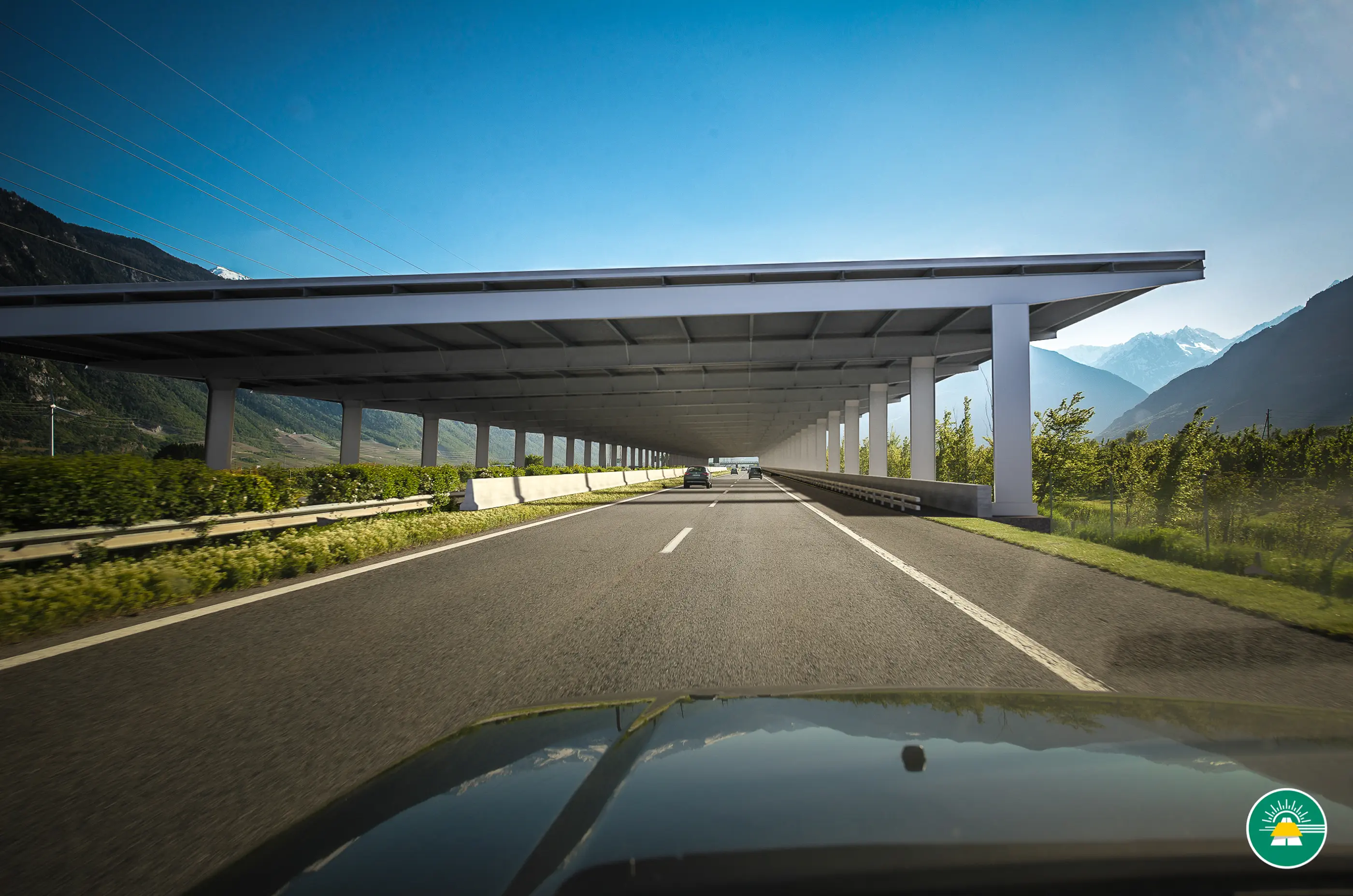
Entrance to the EnergyPier on the A9 motorway at Fully – Valais – Switzerland – Image by EnergyPier AG
With the adoption of the Energy Strategy 2050, Switzerland has set out on a path towards an energy future in which energy is used more efficiently and produced more sustainably, independent of foreign sources.
By 2035, average energy consumption per person in Switzerland must be reduced by 43% compared to the year 2000, whilst increasing electricity production from renewable sources such as solar, wind, biomass and geothermal energy to 14.5 terawatt-hours. The aim is to generate up to 24 TWh of electricity from so-called new renewable energies by 2050.
With efforts towards climate protection and decarbonisation, the electricity sector is growing in importance. This means that if we move away from fossil fuels such as oil – for example in the transport and building sectors – electricity demand will rise.
The expansion of renewable energy is the simplest of all climate protection measures. As the sun is an inexhaustible source of energy, solar power – like all renewable energy – is far more environmentally and climate-friendly than fossil fuels.
Around 60% of the electricity consumed in Switzerland today comes from renewable energy sources, mainly hydropower.
New renewable energy sources account for only a marginal share of the country’s electricity production. Solar energy in particular has great potential for expansion in Switzerland:
Annual sunshine varies by location, ranging from 1,050 to 1,550 kWh/m². In other words, Switzerland’s 41,285 km² receive around 200 times more solar radiation than the country’s total energy consumption. The current use of photovoltaic technology depends only partially on the intensity of solar radiation. The European countries that make the most intensive use of solar energy are found both in the south (Greece, Malta, Italy) and in the centre of the continent (Germany and Belgium). The Swiss Federal Office of Energy (SFOE) estimates that the roofs and facades of Swiss homes could generate 67 TWh of solar electricity per year. This means that solar energy production could be 40 times higher than it is today.
14,000 new jobs over the next five years
A new study by the ZHAW (Wädenswil) on the growth of electricity generation from photovoltaics shows how many new jobs could be created in Switzerland through the increased use of photovoltaics.
This would represent 7,000 new jobs within two years and 14,000 within five years. “If we equip the most easily usable surfaces with solar systems, this will create a need for around 14,000 additional jobs,” explains Jürg Rohrer, author of the study and head of the renewable energy research group at ZHAW. According to the ZHAW study, this could be achieved in a short space of time. 12,000 new jobs would be needed for installation alone, where the basics could be learnt in a matter of days or weeks through short training courses. The remaining 2,000 positions are for specialist planners, for whom, depending on their qualifications, six months of further training would be required.
According to the study’s author, the replacement of older photovoltaic systems will become increasingly important after 2040, meaning that the number of jobs in the photovoltaic industry will rise compared to today.
Lausanne: Electricity to become more expensive from 2021
Significant investments in the electricity grid of the capital of the canton of Vaud will be passed on to consumers’ bills from 1 January 2021, Lausanne Industrial Services announced on Monday.

For a Lausanne household consuming 2,500 kWh per year, the increase will amount to an additional annual cost of 25 francs
Image by Colin Behrens from Pixabay
Electricity tariffs in Lausanne will rise by 1.01 ct/kWh from 1 January 2021, following significant investments in the grid. For a Lausanne household consuming 2,500 kWh per year, this equates to an annual increase of 25 francs.
Due to falling prices on the electricity market, the cost of electricity is decreasing. However, in order to ensure a reliable supply, significant investments have been made in the local grid, explained Lausanne Industrial Services (SiL) in a statement on Monday.
These additional costs necessitate an increase in electricity transmission tariffs. In detail, the price of electricity is falling by an average of 3.6% to 0.29 ct/kWh. The costs of transmitting electricity on the local grid are rising by an average of 7.4% (0.84 ct/kWh).
Changes
The system service costs of 0.16 ct/kWh, levied by Swissgrid to ensure the stability of the national grid, remain unchanged. The same applies to the municipal taxes funding street lighting, the Sustainable Development Fund and the Energy Efficiency Fund. As for the Vaud cantonal electricity tax, it rises from 0.18 ct/kWh to 0.6 ct/kWh.
In line with the city’s future Climate Plan, SiL has been supplying only 100% renewable and 100% regional Nativa electricity since 1 January 2020, they point out. In addition to Lausanne, SiL also supplies electricity to the municipalities of Jouxtens-Mézery, Prilly, Saint-Sulpice, Le Mont-sur-Lausanne, Épalinges and Collonges (VS).
Sources: